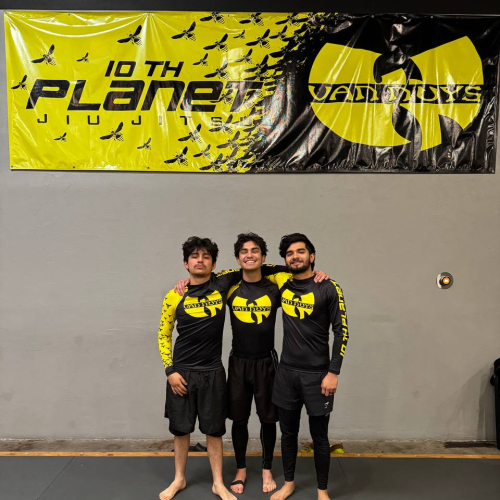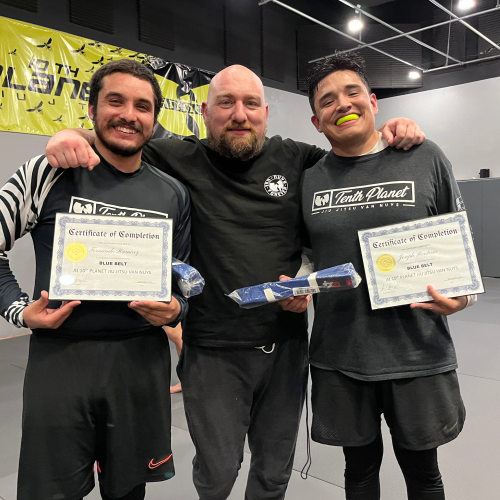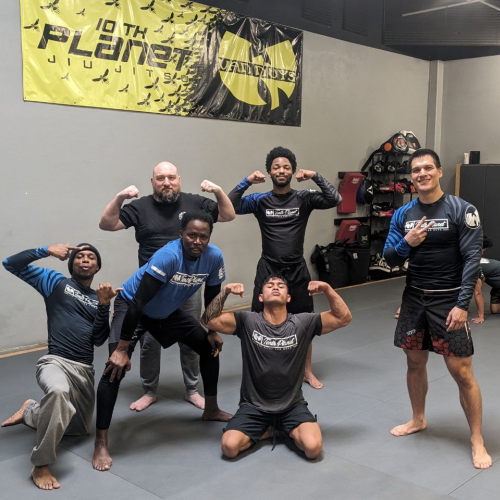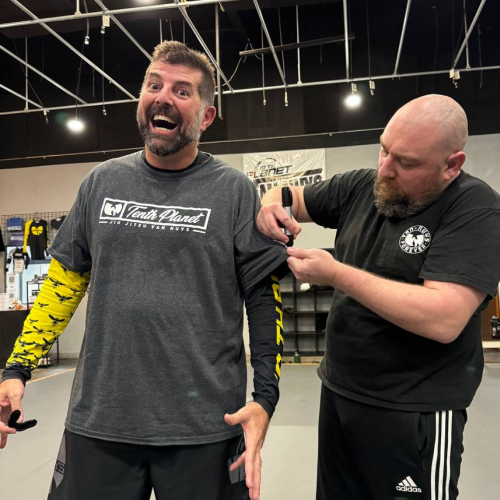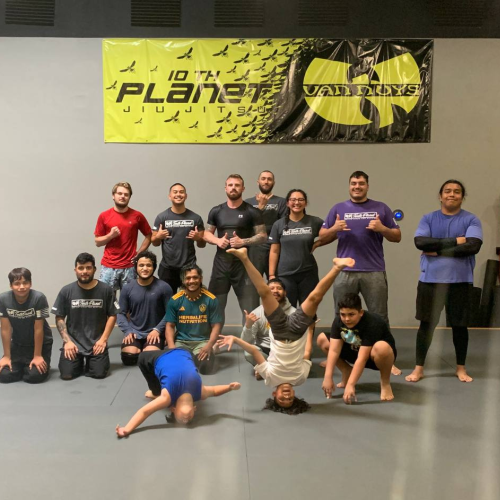
Alder + 10th Planet + Bling = 10th Planet Van Nuys
Introducing 10th Planet Van Nuys - Very Nice!

Alder Hampel was born in 1978 in Portland Oregon. He has been practicing martial arts since the age of 8. He’s trained in such styles as Kung Fu, Karate, Japanese Jiu Jitsu, Tae Kwon Do, Judo, Wrestling, Boxing and Kickboxing. Everything changed for him in 1994 when he witness possibly one of the most revolutionary moments in all of martial arts, UFC 1. As an avid pro wrestling fan, Alder watched as Royce Gracie unmercifully applied finishing hold, after finishing hold, as his opponents were forced to submit. Being as Gracie Jiu Jitsu wasn’t easily accessible to a teen ager with little money, he sought out as much information as he could, reading every magazine he could get his hands on. Until eventually, he met a like minded high school classmate named Robert Hooks jr. Robert trained at the Gracie Academy, and offered to roll with him at his house after school. After Alder was swept, had his guard passed, got mounted and finally submitted, there was no turning back, he was addicted.
Alder began his first BJJ classes in 1996 with the legendary Jean-Jacques Machado. From there he went on to received his blue belt with Renato Magno of Street Sport Jiu Jitsu. It wasn’t until Alder started training with Eddie Bravo in Nogi, that he began to excel in leaps and bounds. He discovered 10th Planet Jiu Jitsu by accident when he visited Chris Reilly’s Muay Thai gym, The Bomb Squad,, across the street from his work in West Hollywood. Although he was familiar with Eddie Bravo, it wasn’t until Alder had actually trained under him, that he saw how innovative 10th Planet Jiu Jitsu actually was.
Although Alder has competed in the past, his true passion is coaching. He stresses the idea of learning how to learn. His ability to fill in his students holes, break down techniques and making techniqes work has by gained him the respect of his students and peers alike. Alder’s teaching method stresses the importance of drilling, sparring, game planning, competing, goal setting and journalling ones progress. He fells this is the way to becoming a complete martial arts. He also believes adjusting ones game, through trial and error, is the road to building a strong game.
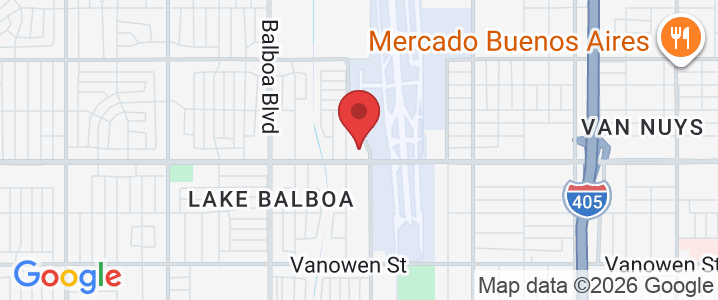
Alder is considered world wide as one of the best ambassadors and instructors for 10th Planet Jiu Jitsu. He has been all over the globe advising upstart 10th Planet Schools and teaching seminars. He also has gained much notoriety because of his blog, www10thplanetwatch.com. Currently, he’s been slowing down on his travels to focus on building his own 10th Planet academy in Van Nuys, California. His new team, along side Saekson”s Muay Thai, trains out of Van Nuys MMA,
Alder has worked with and cornered many amateur and professional MMA fighters. Which includes cornering Dan Hardy for his UFC title fight against Georges St. Pierre. , his goal is to focus on building fighters from the ground up. He believes the truest test of coaches ability is to build something out of nothing. Any gym can be blessed with an amazing athlete, but he believes it’s what you can do with your weakest link that shows a coaches character.
10th Planet Van Nuys
www.10thplanetvannuys.com
“like” http://www.facebook.com/10thPlanetVanNuys
Alder’s links
818-469-1568
info@10thplanetvannuys.com
http://www.facebook.com/alder.hampel
twitter @alder4000
blog: 10thplanetwatch.com
Youtube.com/10thplanetwatch
“A few days after I saw Royce Gracie choke out a host of karate and kung fu practitioners in the first Ultimate Fighting Championship back in 1993, I went out and joined Jean Jacques Machado’s world-renowned jiu-jitsu school, put on a white gi, and hit the mats. In hopes of one day becoming as fierce and respected as Gracie, I did everything the traditional way, which included using the sleeves and collar of my opponent’s uniform to set up all my submissions. As it turned out, I wasn’t the only one trying to emulate Royce Gracie. Millions of martial artists around the world had begun studying jiu-jitsu, including the majority of kick boxers and wrestlers entering the Ultimate Fighting Championship. I tuned into each event, eager to see my fellow jiu-jitsu stylist reap havoc just like Royce had in the early days, but that began happening less and less. They’d do fine in the beginning, snatching out their opponents legs and pulling them down to the mat. But then they would just lie there, clinging to their opponent and trying to avoid punches. And the jiu-jitsu players entering the event were world champions, the best in the business.
I heard a million excuses as to why these champions had faltered, most of which had to do with recent injuries, but it seemed hard for me to believe that every jiu-jitsu player entering the UFC had an injury that kept him from working his magic. One day I sat down and watched a whole slew of fight tapes, and it dawned on me what was happening. It seemed so obvious I couldn’t believe someone hadn’t brought it up. Royce Gracie, who trained exclusively with the gi, had been successful in the first few events because no one knew anything about ground fighting. All he had to do was take them down and choke them out. But with the majority of competitors now versed in submission defense, a jiu-jitsu player had to be extra crafty to catch him in a hold. That was hard to do when they set up all their submission using the color and sleeve of their opponents uniform, which the combatants in the UFC didn’t wear. It seemed logical to stop using the sleeve and collar and start setting up their moves off the over-hooks and under-hooks, which was the very position nearly every Jiu-jitsu competitor in the UFC found himself while grappling with his opponent on the ground and trying to avoid punches. All it would take for the current world champions to rekindle jiu-jitsu’s fury, it seemed, was for them to start training without the gi.
I realized real quickly that this wasn’t going to happen. With the Brazilians, the gi had become some kind of holy garment. Training with the gi was just the way things were done, so that is what students learned. The end result was a bunch of world champion jiu-jitsu players wondering why they were getting their butts kicked when they took off the gi and entered mixed martial arts competition. I could have been more vocal about what I saw, but this was back in ’96, and I was still just a scrawny little blue belt. I probably would have got my head chopped off. So instead of trying to convince everyone, I decided to show them.
I did that in 1991 when I entered the Abu Dhabi World Championships, the largest and most respected no gi grappling tournament in the world, and tapped out Royler Gracie. I managed such a feat not because I was some phemon who born to grapple, but rather because I did what no one else had dared to do, broke the no gi game down into a system.
As expected, I garnered a fair share of enemies in the process. Those who continue to base their livelihoods of teaching others how to grapple with a gi fear what I have to offer. They don’t want people to realize that jiu-jitsu is about the movement, not about what you wear. But despite their opinions of me, I feel it is my obligation to share what I have learned in hopes of saving the sport of MMA. If jiu-jitsu practitioners continue to ground their opponents and just hold on, boring the tears out of the fans, promoters will start implementing stand up rules. If that happens, the sport of mixed martial arts will become nothing more than a glorified Toughman competition. So while the majority of jiu-jitsu black belts throw a bunch of random moves into their books, fearful of divulging the secrets to their success, I have once again broke tradition and put my entire system into my new books, Mastering the Rubber Guard and Mastering the Twister. I’m not only taking your through the step-by-step moves, but also what I am thinking in every move. You are getting my personal game, my personal strategies. You getting techniques that have been proven time again in competition, moves that I’ve spent years refining. Perhaps giving away my entire system will come back to haunt me. Perhaps I’m committing suicide, I don’t know. But the readers are the ones that are going to benefit. They are getting a real game, a real system, not just a random pile of moves. That’s the only way I know how to teach.
So, if you want to learn a style of jiu-jitsu that uses the over-hooks and under hooks to set up submissions, a style that is MMA and street ready, I suggest that you pick up a copy of my books. I also suggest, weather you are a beginning or a jiu-jitsu black belt, that you start with the half guard, which is exactly where I started. Once you have a good grasp of the half guard using no gi techniques, you move on to the full guard. By the time you have mastered all the techniques in my books, you’ll have a leg up on nearly all traditional jiu-jitsu player in a no gi competition. While they are searching for the collar or sleeve that isn’t there, you’ll dominate with submissions utilizing the over-hooks, under-hooks, and head control. You’ll also begin to see that I haven’t thought of everything, that despite what traditional practitioners want you to believe, jiu-jitsu is still evolving. Just like my current students, you’ll start coming up with techniques on your own. You’ll realize that the gi isn’t some religious garment, that it’s the grappling that makes jiu-jitsu the most dominant martial art in the world.”
Eddie “The Twister” Bravo
For more info on Eddie or the 10th Planet System Visit: www.10thPlanetJJ.com
For more info on Eddie’s books and DVD’s, http://www.victorybelt.com